
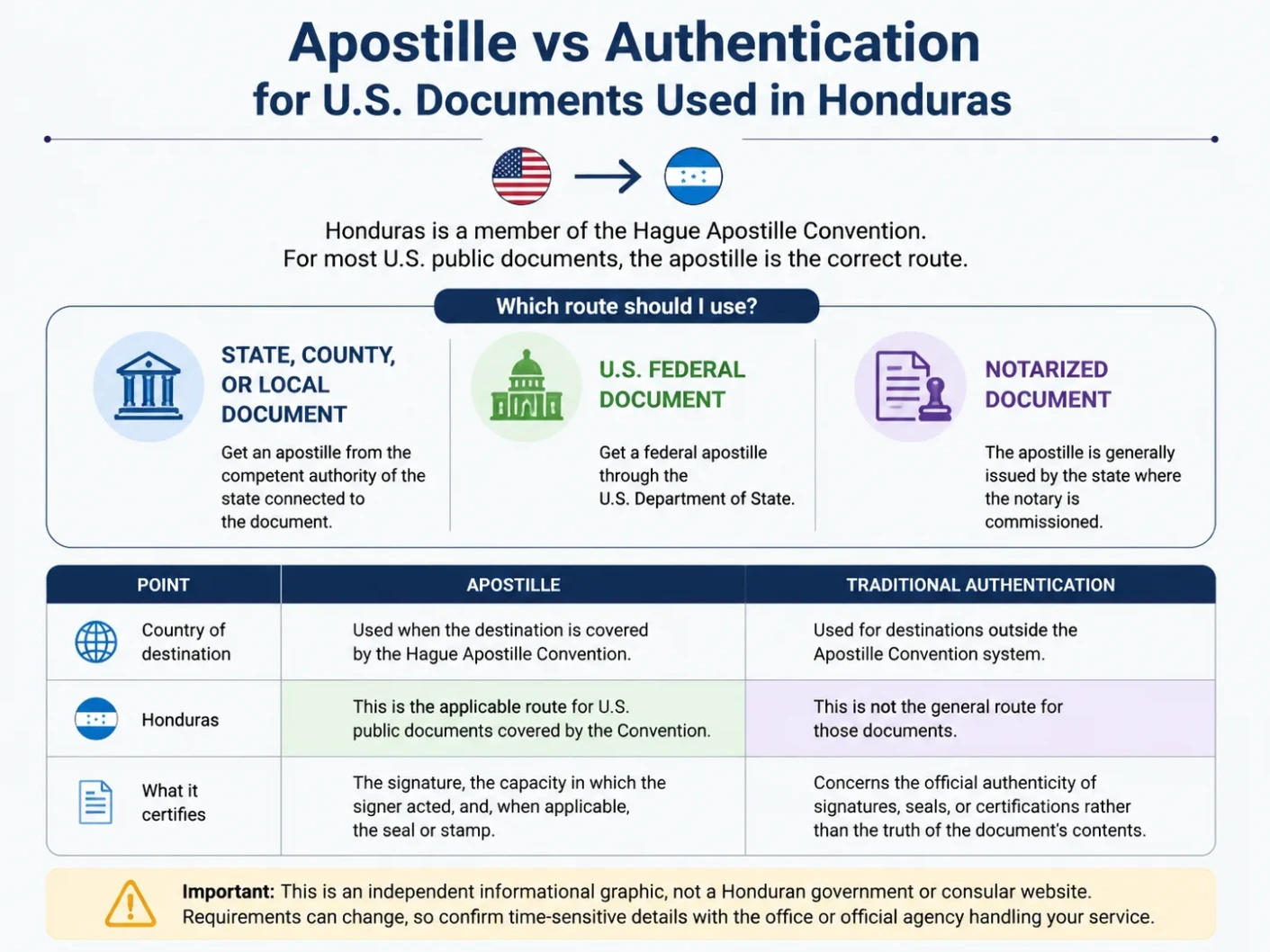
For a document issued in the United States that will be used officially in Honduras, the normal route for a public document covered by the Hague Convention is an apostille, not the traditional authentication and consular legalization chain. Honduras acceded to the Apostille Convention on January 20, 2004, and the Convention entered into force for Honduras on September 30, 2004.[1] The more important question is therefore whether the document was issued by a U.S. state, a federal authority, or signed before a notary. That determines which authority can issue the apostille.
A Texas birth certificate, an FBI background check, and a power of attorney signed before a Florida notary can all be intended for use in Honduras, but they do not follow the same certification route.
Practical rule: A state document is handled by the competent authority of the state connected to that document. A federal document follows the federal apostille route. A notarized document generally depends on the state where the notary is commissioned.
Important: This is an independent informational page, not a Honduran government or consular website. Requirements can change, so confirm time-sensitive details with the office or official agency handling your service.
Apostille vs. authentication when the document will be used in Honduras
| Point | Apostille | Traditional authentication |
|---|---|---|
| Country of destination | Used when the destination is covered by the Hague Apostille Convention. | Used for destinations outside the Apostille Convention system. |
| Honduras | This is the applicable route for U.S. public documents covered by the Convention. | This is not the general route for those documents. |
| U.S. state document | Issued by the competent authority of the relevant state. | May form part of another legalization chain when the destination country is outside the Convention. |
| U.S. federal document | The federal apostille is issued through the U.S. Department of State. | The U.S. Department of State also issues authentication certificates for destinations outside the Convention. |
| What it certifies | The signature, the capacity in which the signer acted, and, when applicable, the seal or stamp. | Also concerns the official authenticity of signatures, seals, or certifications rather than the truth of the document’s contents. |
The U.S. Department of State’s current apostille guidance separates state and federal documents. Documents issued at the state level are handled through the competent authority of the state that issued or certified them, while qualifying federal documents follow the U.S. Department of State apostille process.[2]
The correct apostille authority depends on who issued the document
The document’s name alone does not determine the procedure. Before requesting an apostille, identify whether the document is state or local, federal, or notarized. Two documents described as a “background check,” for example, can follow completely different routes if one was issued by a state agency and the other by the FBI.
Documents issued by a state, county, or local authority
This category commonly includes birth, marriage, and death certificates, state court divorce judgments, and other public records issued within a state. For use in a Hague Convention country, the apostille is obtained through the appropriate authority connected to the state that issued or certified the document, not simply the state where the document holder now lives.[3]
A person who lives in Florida but has a New York birth certificate should therefore not select Florida merely because it is the current state of residence. The origin and certification of the record determine which state authority must handle the apostille.
Documents issued by the U.S. federal government
Federal documents follow a different route. The U.S. Department of State lists examples that include FBI background checks, federal court documents, certain USDA certificates, IRS tax residency certifications, and Certificates of Naturalization issued through the Department of Homeland Security.[4]
A federal document does not become a state document because its owner lives in California, Texas, Florida, or another state. It also should not automatically be sent to the Secretary of State in the applicant’s state of residence.
Powers of attorney, affidavits, and other notarized documents
A privately prepared power of attorney, affidavit, consent form, or authorization may first require a valid notarization before the state authority can authenticate the notary’s signature or commission for apostille purposes. In those cases, the relevant state is tied to the notary’s authority rather than necessarily to the signer’s birthplace or current residence.
There is a Honduras-specific example. The U.S. Department of State states that a consent letter for a minor traveling to Honduras, when notarized in the United States, should be apostilled by the authorities of the state where the notary is registered.[5] This illustrates why the location of the notary’s commission can determine the route for a privately executed document.
Which route applies to common U.S. documents used in Honduras
| Document | Usual origin | Apostille route | Point to review |
|---|---|---|---|
| Birth certificate | State or local authority | Competent authority of the issuing state | Use the certified version accepted by that state; a plain photocopy is not the same as a certified copy. |
| Marriage certificate | State or local authority | Competent authority of the issuing state | The state that issued the record determines the route. |
| Death certificate | State or local authority | Competent authority of the issuing state | Check which type of certified copy the apostille authority accepts. |
| State divorce judgment | State court | State certification and apostille route | A court-certified copy may be required before the apostille. |
| FBI background check | Federal government | U.S. Department of State | It does not go through the apostille office of the state where the applicant lives. |
| Federal court document | Federal government | U.S. Department of State | The document must satisfy federal signature, seal, and certification requirements. |
| Certificate of Naturalization | Federal government | Federal route | Do not notarize the original federal document in an attempt to turn it into a state document. |
| Notarized power of attorney | Private notarized document | State connected to the notary | The notarization must meet the state’s requirements before an apostille is requested. |
| Diploma or transcript | Educational institution | Depends on the certification procedure required by the state | Pre-apostille requirements vary by state and by the type of academic record. |
For birth, marriage, and death records, the issuing state matters more than current residence
One avoidable source of mistakes involves vital records. Moving to another state does not transfer a birth, marriage, or death record from one state to another.
Example: A person born in Texas who now lives in New Jersey should begin with Texas requirements for the birth certificate and its apostille. New Jersey does not become the apostille authority for that record simply because it is now the person’s home state.
The official record must also be distinguished from a reproduction of it. A photocopy made at home does not automatically become a certified copy. If the state requires a certified copy issued by the appropriate vital-records office, that is the version that must be obtained before requesting the apostille.
An FBI background check requires the federal apostille route
An FBI Identity History Summary is a federal document. The FBI explains that its results are authenticated with the FBI watermark and the signature of a division official and can then be submitted to the U.S. Department of State for an apostille when one is required.[6]
A mistake that changes the entire route: Sending an FBI report to a state Secretary of State merely because the applicant resides in that state. The FBI is a federal agency, so its apostille follows the federal process.
A background check issued by state police or another local authority should not be confused with an FBI Identity History Summary. The issuing authority remains the detail that determines the certification route.
Powers of attorney signed in the United States: notarization and apostille are separate steps
For a power of attorney signed before a U.S. notary, notarization and apostille do not perform the same function. The notary performs the required notarial act for the signature. The competent state authority can then certify the notary’s official capacity through an apostille when the document is intended for Honduras.
The apostille office should therefore not be selected according to the location of a property, bank, inheritance, or representative in Honduras. For the U.S. apostille, the relevant questions are where the notarial act was performed and which state has authority over that notary.
The apostille also does not determine whether the text of a power of attorney gives the representative sufficient authority to sell property, complete a banking transaction, handle an inheritance, or appear before a Honduran institution. Those requirements concern the intended use and contents of the power, not the apostille itself.
Originals, certified copies, and photocopies are not interchangeable
For federal documents, the U.S. Department of State states that a document submitted for an apostille must be an original or certified copy and contain the required official elements, including a legible signature, the official’s printed name and title, the agency’s seal, and the date of issuance when applicable.[4]
The same federal instructions contain an important warning: do not notarize the original federal document. The Department of State states that doing so can invalidate it for the authentication process.[4]
For state documents, preparation requirements depend on the competent state authority. A vital record, court judgment, diploma, and notarized power of attorney should not be treated as though all four require exactly the same certification steps before an apostille can be issued.
An apostille does not eliminate a possible Spanish translation requirement
An apostille addresses the international certification of a signature, official capacity, seal, or stamp. It does not translate the underlying document. A Honduran institution receiving a document written in English can have separate requirements concerning translation into Spanish.
For federal documents, the U.S. Department of State states that when the destination country requires translation from English, a professional translation should be obtained and the translated copy notarized. The federal instructions distinguish that translation from the original federal document, which should not itself be notarized.[4]
A translation prepared for one purpose should not automatically be assumed to meet every Honduran institution’s requirements. A civil registry office, university, bank, court, or administrative agency can apply requirements specific to the transaction for which the document is being presented.
What an apostille certifies—and what it does not decide
Honduras’s Secretaría de Relaciones Exteriores y Cooperación Internacional describes authentications and apostilles as procedures that certify the authenticity of a signature, the capacity in which the signer acted, and, when applicable, the identity of the seal or stamp attached to the document.[7]
That function is not the same as approving the substance of the document. An apostille does not establish that a private statement is true, that a diploma has a particular academic equivalency, that a foreign judgment automatically produces all possible legal effects in Honduras, or that a power of attorney contains sufficient authority for a particular transaction.
A valid apostille does not mean the Honduran procedure is finished: The receiving institution may separately require a translation, registration, presentation of an original, a recently issued record, or specific wording or contents.
Why Honduras uses the term “Authentications and Apostilles”
Honduras’s Secretaría de Relaciones Exteriores officially uses the service name “Auténticas y Apostillas” for its certification services.[7] Seeing both terms together does not mean that every U.S. document intended for Honduras must first receive an authentication and then an apostille as two mandatory consecutive certifications.
In the United States, “authentication certificate” also has a specific administrative meaning. Current U.S. Department of State guidance separates apostille processing for Hague Convention destinations from authentication processing used for destinations outside that system.[2] Separating the destination-country rule from the name of a Honduran government service prevents the two procedures from being mixed together.
The State Department Honduras page contains conflicting apostille information
Check the date and section: The current status field at the top of the U.S. Department of State’s “Honduras Judicial Assistance Information” page says “Party to Hague Apostille Convention? Yes.” On the same page, the legacy “Authentication of Documents” section still says Honduras is not a party and describes authentication followed by Honduran Embassy legalization. That legacy section is tied to a last-updated date of November 15, 2013.[8]
The page is therefore internally inconsistent on this point. The current HCCH status table, updated June 30, 2026, records Honduras’s accession on January 20, 2004, with the Convention entering into force on September 30, 2004.[1] For current apostille routing, use the HCCH status record together with the U.S. Department of State’s current apostille instructions rather than the legacy 2013 authentication paragraph.[2]
Federal apostilles have their own U.S. Department of State requirements
For a federal apostille request, the U.S. Department of State requires Form DS-4194, the document that needs certification, and the applicable fee. The published federal fee is $20 per document and is nonrefundable.[9]
That federal fee should not be used as the expected cost for a state birth certificate, state-notarized power of attorney, or another document handled directly by a state authority. Individual states set their own apostille procedures, forms, fees, and delivery methods.
The Honduran institution receiving the document may require more than an apostille
Before paying for copies, notarizations, apostilles, or translations, identify exactly what the receiving institution in Honduras requires. The U.S. authority determines whether a particular signature or seal can be certified through an apostille. The Honduran institution determines whether the resulting document satisfies the requirements of the transaction or filing for which it is being submitted.
- Determine whether the institution requires the original document or a certified copy.
- Check whether the document must have been issued within a particular period.
- Determine whether an English-language document must be translated into Spanish.
- For powers of attorney and authorizations, make sure the document contains the powers required for the intended transaction in Honduras.
- For civil records, court judgments, or academic records, distinguish the apostille from any later registration, recognition, or validation required in Honduras.
A useful way to identify the correct route before mailing a document is to establish four facts: who issued it, whether it was issued at the state or federal level, whether a notarial act is involved, and which institution in Honduras will receive it. Those details distinguish most state, federal, and notarized-document cases without beginning a certification chain that does not apply.
Official Sources
- [1] HCCH — Status Table for the Apostille Convention — The official status table records Honduras’s accession on January 20, 2004, and entry into force on September 30, 2004.
- [2] U.S. Department of State — Preparing Your Document for an Apostille Certificate — Current apostille guidance for Hague Convention destinations, including separate routes for state-issued and federal documents.
- [3] National Association of Secretaries of State — Apostilles/Document Authentication Services — Directs state apostille requests to the appropriate state authority associated with the document being certified for international use.
- [4] U.S. Department of State — Prepare a Document for an Apostille Certificate — Covers federal documents, including FBI records and naturalization certificates, original or certified-copy requirements, and the warning not to notarize an original federal document.
- [5] U.S. Department of State — Honduras International Travel Information — States that U.S.-notarized minor travel consent letters for Honduras should be apostilled by the authorities in the state where the notary is registered.
- [6] FBI — Identity History Summary Checks Frequently Asked Questions — Explains that FBI-authenticated Identity History Summary results can be submitted to the U.S. Department of State for an apostille when required.
- [7] Secretaría de Relaciones Exteriores y Cooperación Internacional — Verificación de Auténticas y Apostillas — Describes certification of the signature, the signer’s official capacity, and the identity of the seal or stamp.
- [8] U.S. Department of State — Honduras Judicial Assistance Information — The current status field says Honduras is a party to the Apostille Convention, while the legacy 2013 authentication paragraph on the same page still says it is not.
- [9] U.S. Department of State — Request Authentication Services — Publishes Form DS-4194 and the federal nonrefundable fee of $20 per document.