
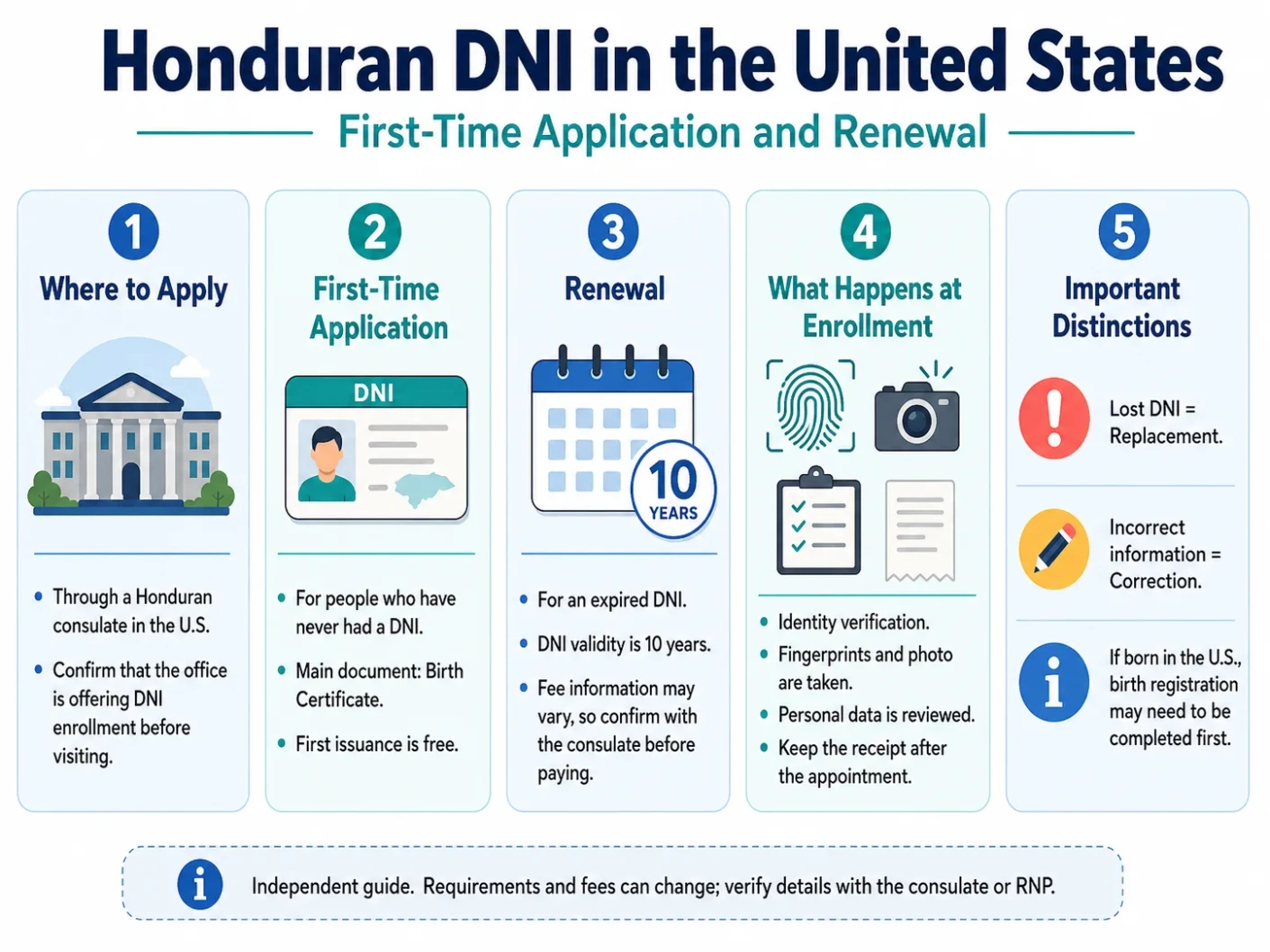
The Honduran DNI can be processed from the United States through consular services when the corresponding office is providing DNI enrollment. Before starting, it is important to distinguish between a first-time application, renewal, replacement, and correction. The Registro Nacional de las Personas (RNP) treats these as different procedures, and they do not necessarily have the same requirements or payment rules. [1]
For Hondurans living abroad, the RNP states that DNI applications can be handled through Honduran consulates. Enrollment includes the capture of fingerprints, a photograph, and sociodemographic information. The first DNI is free, and according to the RNP’s frequently asked questions, a new issuance after the DNI reaches its 10-year expiration does not require payment, while replacement after loss is subject to a fee. [2]
Important: This is an independent informational page, not a Honduran government or consular website. Requirements can change, so confirm time-sensitive details with the office or official agency handling your service.
Determine which DNI procedure applies
The reason you need another card determines the procedure. An expired DNI is not the same as a lost DNI, and incorrect personal information is not necessarily resolved through renewal. The RNP itself maintains separate procedures for initial applications, corrections, and renewals or replacements.
| Situation | Procedure | What it means |
|---|---|---|
| You have never received a DNI | First-time application | You need to complete enrollment to obtain the document for the first time. |
| Your DNI reached the end of its validity period | Renewal | A previous DNI already exists and a new one must be issued because the existing document has expired. |
| You lost your DNI | Replacement | The document had already been issued but must be replaced because it was lost. |
| The DNI contains incorrect information | Correction | The RNP handles correction of DNI information as a separate procedure. |
This distinction helps prevent situations such as requesting a “renewal” when a replacement is actually required, or submitting another card request when the underlying issue involves a name, surname, date of birth, or other civil-registry information.
Where to apply for a Honduran DNI in the United States
The RNP states that Hondurans living abroad can apply through Honduran consulates. Honduras’s Secretaría de Relaciones Exteriores y Cooperación Internacional has also specifically included enrollment for the National Identification Document among services offered at a U.S. consular location, as shown in an official notice concerning the Honduran Consulate in Houston. [3]
This does not mean every consular office or every mobile consulate provides DNI enrollment every day. Before traveling, confirm specifically that the office you plan to visit is currently handling DNI enrollment and determine how that service is being provided. Having an appointment for another consular service does not by itself confirm that DNI enrollment equipment and personnel will be available.
When contacting the consulate: state whether you need a first-time application, renewal, replacement, or correction, and ask specifically whether that location is conducting DNI enrollment on the date you plan to visit.
First-time DNI application from the United States
For a first-time application, the RNP’s official requirements sheet lists a Birth Certificate as the required supporting document and states that no TGR-RNP payment is required. The same document allows citizens between ages 16 and 18 to submit an application, although it states that the DNI is delivered once the applicant turns 18. [4]
First-time application according to the RNP: a Birth Certificate is the published requirement, and no TGR-RNP payment is required.
Additional documents a consular office may request
The RNP’s national requirements sheet for a first-time application does not list a Honduran passport, U.S. driver’s license, U.S. proof of address, or witnesses as general requirements. The document is also written for RNP identification offices in Honduras rather than as a separate checklist for each Honduran consulate in the United States.
For that reason, documents mentioned on unofficial websites should not be treated as universal DNI requirements. A consular office may establish additional operational requirements to identify an applicant or handle a particular case. When that happens, follow the document instructions published or provided by the office that will conduct the enrollment.
Applicants between ages 16 and 18
The RNP’s published requirement allows an application to be initiated between ages 16 and 18 but states that the document is delivered after the applicant turns 18. For applications in the United States, confirm beforehand that the selected consular location is enrolling applicants in this age group.
Renewing a Honduran DNI
Renewal applies to a citizen who already has a DNI and needs a new issuance because the document has expired. The RNP’s FAQ states that the DNI expires after 10 years and says that a new issuance at that point does not require payment; it identifies replacement as the situation in which a fee applies.
There is, however, a difference within the RNP’s own published information. A PDF titled “Requirements to Request Renewal or Replacement of an Identity Card” lists a Birth Certificate and shows a L 200 TGR-RNP payment for the combined renewal or replacement category. [5]
The official instructions contain a payment discrepancy: the RNP FAQ states that renewal after a DNI expires at 10 years does not require payment and that the charge applies to replacement, while the RNP PDF covering “renewal or replacement” shows a TGR-RNP payment of L 200. The reviewed pages do not provide an update date that resolves this difference with certainty. Before making a payment for a renewal from the United States, confirm with the consular office which fee applies specifically to your case.
A Birth Certificate is expressly listed in the RNP requirements sheet for renewal or replacement. That publication does not contain a separate document checklist for renewals completed at a U.S. consulate, so any additional consular requirement should be verified with the office that will perform the service.
Replacement and correction are not the same as renewal
If you lost your DNI
The RNP treats loss of a DNI as a replacement. Its FAQ states that the first issuance is free, but a person who loses the document must complete a replacement procedure and pay the corresponding charge. Losing a DNI that was still valid therefore does not turn the case into a renewal.
If your name or other information is incorrect
When the problem is incorrect information, the RNP publishes a separate DNI correction procedure. Requesting another card without first addressing the registry error may leave the underlying problem unresolved. If your first name, surname, date of birth, or other information does not match the correct civil record, tell the staff that the case involves a correction rather than only a renewal.
What happens during DNI enrollment
DNI enrollment involves more than submitting documents. The RNP defines enrollment as the capture of biometric and sociodemographic information used to generate the DNI. The biometric information includes fingerprints and a photograph.
- Applicant identification. The RNP states that the identity number is provided during enrollment.
- Verification of civil-registry information. The information identifying the applicant must correspond with the applicant’s Honduran record.
- Fingerprint capture. Fingerprints form part of the biometric record used to produce the document.
- Photograph. The photograph is taken during enrollment by the corresponding unit; the RNP FAQ describes it as part of the capture performed at the place of enrollment.
- DNI production. Biometric capture begins the document-generation process; it does not mean that the physical card will be handed over at that same moment.
The RNP FAQ also states that the applicant’s face must be visible for the enrollment photograph and instructs applicants not to wear dark glasses, a cap, or a hat during capture. Because the photograph is taken by the enrollment unit, the RNP’s general requirements do not request a printed passport-style photo for this procedure.
If you were born in the United States and have never had a DNI
For someone born in the United States to a Honduran mother or father, the first issue to determine is whether the birth has already been entered in Honduras’s Registro Nacional de las Personas. The RNP states that children born abroad to a Honduran parent can be registered through Honduran diplomatic or consular officials, who forward the certification so that the birth can be incorporated into the Honduran civil registry. [6]
If the person does not yet have that Honduran birth registration, the issue is not simply obtaining a DNI. The birth registration that establishes the person in the RNP system must first be resolved. If the birth is already registered and the person has the corresponding identity number, the next step is to ask the consulate about a first-time DNI application.
What to do after enrollment
There is no need to immediately begin another application simply because enrollment was completed and the card has not yet arrived. The RNP maintains separate tools for checking the status of the enrollment process and for locating a DNI that has already reached the delivery stage.
Check the status of your enrollment
The official Enrollment Status application allows users to check the history of processes related to the generation of a National Identification Document. [7]
Official enrollment status: Open the RNP Enrollment Status tool
Check where your DNI is located
The RNP also provides a separate tool for checking the location of a DNI using the identification number. [8] This can be useful when enrollment has already been completed but it is unclear whether the physical card has reached its delivery location.
DNI location: Check the location of your DNI through the RNP
Keep your receipt for DNI delivery
The RNP’s official DNI page states as a general rule that delivery is personal and that the citizen must present the corresponding receipt, referred to by the RNP as the contraseña. For a procedure completed in the United States, keep any receipt or contraseña issued during enrollment and follow the collection instructions provided by the consular office.
There is no single published delivery time for every U.S. consulate
The RNP FAQ contains a general reference to delivery approximately one month after enrollment. However, the same page retains instructions connected with the original DNI enrollment process and does not present that timeframe as a current, U.S.-specific standard for consular applications. It should therefore not be treated as a guaranteed delivery date for an application currently completed in the United States.
To determine whether a case is progressing, first use the Enrollment Status system and then the DNI location tool. If the document appears at a location other than the one expected, or the system does not reflect an enrollment that was completed, contact the office where the enrollment took place.
Cases that should be clarified before repeating the DNI procedure
You enrolled but never received the card
Before presenting yourself as a first-time applicant, check both the enrollment status and the DNI location. An existing enrollment may still be at another stage of processing and does not necessarily require starting again.
You only have an old Honduran identity card
The RNP publishes first-time applications and renewals as DNI categories, but its general DNI page does not provide a separate rule for every person who still has an identity card from the previous system and never received the current DNI. When contacting the consular office, state specifically that you have an old Honduran identity card and explain whether you ever completed enrollment for the current DNI. This allows the office to determine the correct procedure without incorrectly classifying the case.
Your information does not match your other Honduran documents
A difference involving your first name, surname, date of birth, or other civil-registry information should be raised as a possible correction case. The issue is not only obtaining another physical card; the underlying registry information may need to be reviewed so that a new DNI does not reproduce incorrect data.
Official Sources
- [1] RNP — National Identification Document — The official RNP page separates initial applications, corrections, and renewal or replacement procedures and publishes the general rule for personal delivery with the corresponding receipt.
- [2] RNP — Frequently Asked Questions About Enrollment and the DNI — Explains biometric enrollment, processing through consulates for Hondurans abroad, free first issuance, replacement after loss, and the published rule for expiration after 10 years.
- [3] Honduran Ministry of Foreign Affairs — Notice on Consular Services in Houston — An official document that includes enrollment for the National Identification Document among consular services provided at a U.S. location.
- [4] RNP — Requirements for a First-Time Identity Card Application — Lists the Birth Certificate requirement, states that no TGR-RNP payment is required, and provides the rule for applicants between ages 16 and 18.
- [5] RNP — Requirements for DNI Renewal or Replacement — The official requirements sheet lists a Birth Certificate and shows a TGR-RNP payment of L 200 for the combined renewal or replacement category.
- [6] RNP — Births Occurring Abroad — Explains registration of children born outside Honduras to a Honduran parent through Honduran diplomatic or consular officials.
- [7] RNP — Enrollment Status — The official tool for checking the history of processes related to generation of the DNI.
- [8] RNP — Check the Location of Your DNI — The official tool for checking where a National Identification Document is located.