
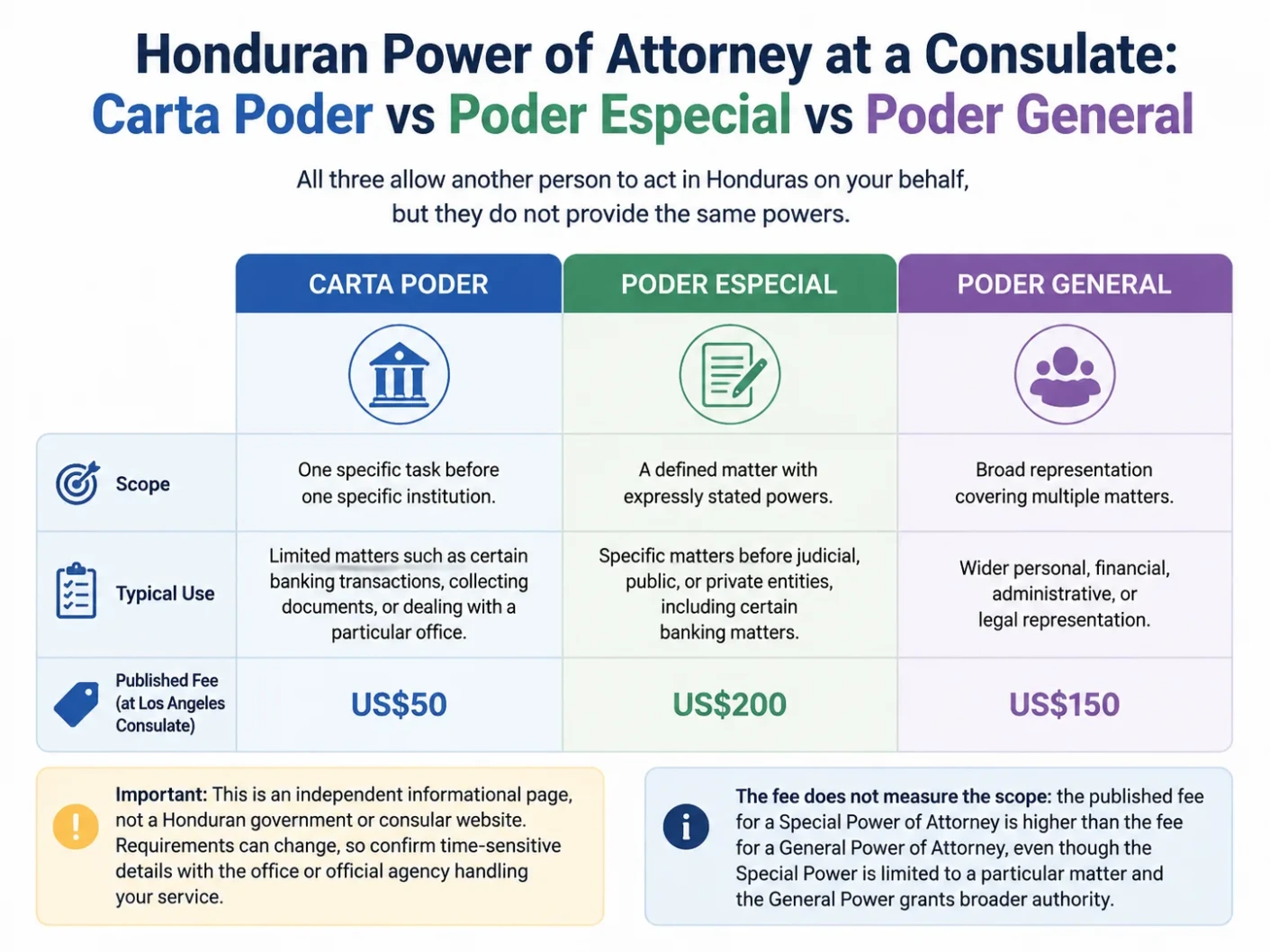
Carta Poder, Poder Especial (Special Power of Attorney), and Poder General (General Power of Attorney) all allow another person to act in Honduras on behalf of the person granting the authority, but they do not provide the same powers. A Carta Poder is intended for a specific task before a particular institution; a Special Power of Attorney authorizes a defined matter with the powers needed to complete it; and a General Power of Attorney provides much broader representation across multiple matters. On the service pages published by the Honduran Consulate in Los Angeles, the listed fees are US$50 for a Carta Poder, US$200 for a Special Power of Attorney, and US$150 for a General Power of Attorney. The fee therefore does not indicate how broad the authority is.
Important: This is an independent informational page, not a Honduran government or consular website. Requirements can change, so confirm time-sensitive details with the office or official agency handling your service.
Differences Between Carta Poder, Special Power, and General Power
The distinction used by Honduran consular offices is based mainly on what the representative is allowed to do, where the representative may act, and how broad the granted powers are. The Honduran Consulate in Los Angeles limits a Carta Poder to a particular institution, describes a Special Power of Attorney as authority for a specific matter, and presents a General Power of Attorney as broad authority covering personal, financial, and legal matters.
| Document | Scope | Typical Use | Published Fee |
|---|---|---|---|
| Carta Poder | One specific task before one specific institution | Limited matters such as certain banking transactions, collecting documents, or dealing with a particular office | US$50 [1] |
| Special Power of Attorney | A defined matter with expressly stated powers | Specific matters before judicial, public, or private entities, including certain banking matters | US$200 [2] |
| General Power of Attorney | Broad representation covering multiple matters | Wider personal, financial, administrative, or legal representation | US$150 [3] |
The fee does not measure the scope: the published fee for a Special Power of Attorney is higher than the fee for a General Power of Attorney, even though the Special Power is limited to a particular matter and the General Power grants broader authority.
Carta Poder and Special Power Can Both Be Specific, but They Are Not the Same
The word specific appears in descriptions of both documents, which is where much of the confusion begins. With a Carta Poder, the limitation is primarily tied to a particular task and a particular institution. With a Special Power of Attorney, the limitation applies to the specific matter being authorized and the powers granted to carry it out.
A Carta Poder can fit when someone needs to act for you at one office for a clearly identified task. A Special Power of Attorney becomes relevant when the transaction requires particular legal powers, such as handling a defined proceeding, completing a specific transaction involving property, or carrying out an act that requires express authority.
One practical distinction is especially useful: the Los Angeles consular page expressly describes a Carta Poder as applying to one specific institution. Its Special Power of Attorney page, by contrast, states that the authorized matter may be handled before judicial, public, or private entities.
When a Carta Poder Fits the Transaction
The Los Angeles consular page describes a Carta Poder as a document through which a person authorizes a relative or representative to perform a task on the person’s behalf before a non-judicial entity. Published examples include management of certain bank accounts, payment of bills, collection of documents, withdrawal of contributions, and certain school-related matters. The same page establishes an important limit: the Carta Poder is for the same institution.
A Carta Poder is easier to identify when two questions have precise answers: What exactly will the representative do? and At which institution will it be done? The more open-ended the answers become, the less closely the transaction matches the consular description of a Carta Poder.
When a Bank Account or Property Is Involved
For a Carta Poder involving a financial institution or property, the Honduran Consulate in Los Angeles publishes more specific requirements. For banking matters, it requests documentation identifying details such as the account number and financial institution. When the matter concerns real estate, it states that a copy of the corresponding property registration information should be presented. These details help identify the exact account or property covered by the authorization.
When a Special Power of Attorney Is Used
A Special Power of Attorney is used when an attorney-in-fact or other representative will act for the grantor in a particular transaction or matter. The Honduran Consulate in Los Angeles specifically states that this representation may be exercised before judicial, public, or private entities, including banks. Another Honduran consular office, the Consulate in Madrid, lists examples such as the sale of property, a banking transaction, and a judicial proceeding, illustrating the kinds of matters that can require specifically stated powers.[6]
Simply stating that another person will “represent” the grantor is not enough to determine what that person can legally do. The document needs to correspond to the transaction that will actually take place in Honduras. Authority to collect documents, for example, should not be treated as automatically equivalent to authority to sell property, appear in a proceeding, or complete a different financial transaction.
The Granted Powers Must Match the Authorized Act
For a Special Power of Attorney, the matter should be identified with enough detail to show who is being represented, who will act as the representative, which institution or proceeding is involved, which property or account is affected when applicable, and what actions the representative needs authority to perform. Consular pages dealing with Special Powers also warn that a draft that does not correspond to the requested type of power may be returned before the document is formalized.
If a bank, attorney, court, registry, or other institution in Honduras has already stated which powers must appear in the document, that information should be obtained before the consular appointment. The title “Special Power of Attorney” does not by itself supply every authority needed for the underlying transaction.
How Broad a General Power of Attorney Can Be
A General Power of Attorney is intended for broader representation. The Honduran Consulate in Los Angeles describes it as authority to conduct matters in Honduras before judicial, public, and private entities, including banks, and includes powers related to the grantor’s property. That breadth separates it from both a Carta Poder limited to one institution and a Special Power of Attorney centered on a defined matter.
There is no advantage in automatically choosing the broadest document when the representative only needs to complete one defined transaction. Each additional authority increases what the representative may be able to do in the grantor’s name. The scope should therefore be based on the actions that are actually required rather than on an attempt to avoid another consular visit later.
Scope of authority: a General Power of Attorney is not automatically a “better” version of a Special Power. It is broader. If only one transaction requires defined powers, additional authority may not match the purpose of the document.
Which Type of Power to Review for Common Transactions in Honduras
The situations below reflect distinctions found in consular descriptions. Banking and property matters may fall under more than one document because different transactions require different authority. Collecting a document from a bank is not the same act as disposing of property or signing a financial transaction for the account holder.
| Transaction in Honduras | Document to Review First | Why |
|---|---|---|
| Collect documents or complete a defined task at one institution | Carta Poder | The Carta Poder is limited to a specific matter at a specific institution. |
| Handle a limited matter involving an account at a particular bank | Carta Poder | Consular descriptions include certain banking matters among Carta Poder uses. |
| Complete a banking transaction requiring expressly granted powers | Special Power of Attorney | The authorized financial act can be defined precisely. |
| Sell a specific property | Special Power of Attorney | The sale of property appears among published examples of a specific authorized matter. |
| Represent the grantor in a particular judicial proceeding | Special Power of Attorney | The authority can be limited to that proceeding and the powers required for it. |
| Handle several matters before different institutions | General Power of Attorney | It is designed for broader representation across multiple matters. |
| Broadly manage personal, financial, and property matters | General Power of Attorney | The published scope includes broad representation before public, private, and judicial entities. |
The institution that will receive the document in Honduras remains an important part of the decision. If a bank, court, registry, or other entity requires a particular authority, a narrower document may not cover that act even when its title appears related to the transaction.
The Wording Can Matter More Than the Name of the Power
Two Special Powers of Attorney can grant very different authority because they were drafted for different transactions. The same applies to General Powers of Attorney: their actual scope depends on the language in the instrument. Choosing between “Special” and “General” is therefore only part of the decision. The document must also define what the representative is authorized to do.
- Act: the specific transaction the representative must perform.
- Institution: the bank, registry, court, municipality, government agency, or private entity involved.
- Subject: the property, account, case file, contract, or other item that needs to be identified.
- Powers: the actions the representative is authorized to carry out.
- Limits: matters that should remain outside the representative’s authority.
A broad phrase such as “handle paperwork” should not be assumed to mean the same thing as more specific authority to sell, sign, dispose of property, collect funds, or appear in a proceeding. When a transaction in Honduras requires a particular act, the instrument ultimately issued must provide authority for that act.
When to Prepare a Draft or Testimonio Before the Appointment
The Special Power and General Power pages of the Honduran Consulate in Los Angeles list a model of the power’s testimonio requested from an attorney in Honduras among their requirements. They also state that the content will be reviewed and that a draft that does not match the requested type of power may be returned.
This preparation is particularly relevant when the document will affect property, judicial matters, or financial transactions. Getting instructions first from the person or institution that will receive the power can establish which facts and powers need to appear in the document before the consular appointment.
Check submission instructions carefully: the Special Power and General Power pages for the Los Angeles Consulate currently display, within the draft requirement, an email address associated with the Honduran Consulate in Madrid. Do not send personal documents to an address belonging to another office without first confirming the correct submission channel with the consulate where the service will be completed.
Information and Documents to Define Before Granting the Power
Exact requirements depend on the consular office and the type of instrument. As a specific U.S. reference, the service pages of the Honduran Consulate in Los Angeles publish identification requirements for both the person granting the power and the person who will receive the authority.
Information About the Grantor
- Honduran DNI, according to the published requirement for the service.
- Passport or another identity document when required by the service page.
- Personal information needed to prepare the instrument.
- Details of the matter that will be handled in Honduras.
- Property, account, or registration information when identifying the subject of the transaction is necessary.
Information About the Person Receiving the Power
- Full name.
- Legible copy of the person’s identification document.
- Address in Honduras when requested.
- Professional information and a copy of the Honduran Bar Association credential if the power is granted to an attorney and the office requires it.
The Los Angeles service pages describe the possible representative as an attorney or a trusted person. This means a power does not automatically have to be granted to an attorney simply because it is a power of attorney. A separate issue is whether the underlying procedure in Honduras requires professional legal representation.
Who Must Appear at the Consulate
The Carta Poder, Special Power, and General Power pages of the Honduran Consulate in Los Angeles state that the consular procedure is in person and personal. The grantor is the person who appears to execute the instrument. The published requirements separately request a copy of the identification of the person who will receive the authority.
For appointments, the Honduran Ministry of Foreign Affairs and International Cooperation maintains its Consular Services System through the official Cita Consular portal.[4]
Official consular appointment: Open the Honduran Consular Services System
Some consular pages may still display links associated with older systems. For a new appointment, use the system currently maintained by SRECI and then select the available service for the appropriate consular office.
How to Read the Fees and Payment Rules
The three fees published on the Los Angeles service pages are US$50 for a Carta Poder, US$200 for a Special Power of Attorney, and US$150 for a General Power of Attorney. The price difference cannot be used to determine which document grants the broadest authority: the Special Power costs US$50 more than the General Power even though its purpose is more limited.
The payment method should be checked with the office where the service will be performed. For the Honduran Consulate in Los Angeles specifically, the pages reviewed state that cash is not accepted and payment can be made by debit or credit card. That payment method should not automatically be assumed to apply at every Honduran consulate in the United States.
Questions That Help Determine the Correct Scope
Before selecting a service for the consular appointment, the transaction should be describable in concrete terms. If the situation can only be summarized as “I need someone to handle my affairs in Honduras,” there is not yet enough detail to distinguish reliably among the three options.
- Define the act: identify whether the representative must collect, receive payment, sign, sell, represent, administer, or perform another specific action.
- Identify the institution: determine where the representative will use the document.
- Determine whether one or several institutions are involved: this distinction is particularly important for a Carta Poder.
- Identify the property, account, or case: gather registration numbers, account details, case numbers, or other identifiers when they are part of the transaction.
- Obtain the required powers: if a bank, attorney, court, or Honduran institution requires particular wording or authority, define it before the appointment.
- Select the scope: consider Carta Poder for a limited transaction that fits its definition, Special Power for a defined matter requiring express powers, or General Power when broad representation is genuinely necessary.
An Authorization for a Minor Is Not Automatically One of These Powers
Honduran consular services also treat Authorizations as a separate category from Carta Poder, Special Power of Attorney, and General Power of Attorney. This distinction matters when the issue involves a minor’s passport, international travel, or another form of parental authorization. A power should not be selected merely because another person will act with a parent’s permission; the specific consular service required for the child’s situation should be identified first.
What to Check Before Sending the Power for Use in Honduras
After receiving the consular instrument, do not add an apostille or legalization step on your own assumption that every power follows the same route. SRECI defines an Auténtica within its document legalization services for documents intended to have legal effect in Honduras, including documents connected with Honduran diplomatic or consular authorities abroad.[5]
That definition establishes that a legalization procedure exists, but it does not by itself establish that every General Power, Special Power, or Carta Poder must go through the same additional step. Before sending the document, determine what the receiving institution in Honduras requires and what instructions were provided by the consular office that issued the document.
When the Power Is Too Narrow or Too Broad for the Transaction
A power can be properly issued by a consulate and still fail to cover the intended transaction if the written authority does not match what the representative needs to do. This can happen when a Carta Poder is prepared for one institution but the matter later requires action before another office, or when a Special Power identifies the matter but leaves out an act needed to complete it.
The reverse can also happen: a person may grant a General Power of Attorney for a transaction that only required narrowly defined authority. The instrument operates according to the authority it actually contains, so the decision should focus on what the representative needs to be able to do and what authority the representative does not need.
Practical way to distinguish them: one defined task at one institution points toward a Carta Poder; a specific matter requiring expressly stated powers points toward a Special Power of Attorney; multiple matters and broad representation point toward a General Power of Attorney. The final wording still needs to cover what the receiving institution in Honduras requires.
Official Sources
- [1] Carta de Poder — Honduran Consulate in Los Angeles — Publishes the scope of a Carta Poder, its limitation to one institution, requirements, payment information, and the US$50 fee.
- [2] Poder Especial — Honduran Consulate in Los Angeles — Describes representation for a specific matter before judicial, public, or private entities and publishes the US$200 fee and service requirements.
- [3] Poder General — Honduran Consulate in Los Angeles — Explains the broad scope of representation and publishes the US$150 consular fee and related requirements.
- [4] Consular Services System — SRECI — Official Ministry of Foreign Affairs and International Cooperation portal for starting the Honduran consular appointment process.
- [5] Frequently Asked Questions — SRECI — Explains the concept of an Auténtica and the legalization of documents intended to have effect in Honduras.
- [6] Poder Especial — Honduran Consulate in Madrid — A Honduran consular office that gives examples of Special Power matters including sale of property, certain banking transactions, and judicial proceedings.