
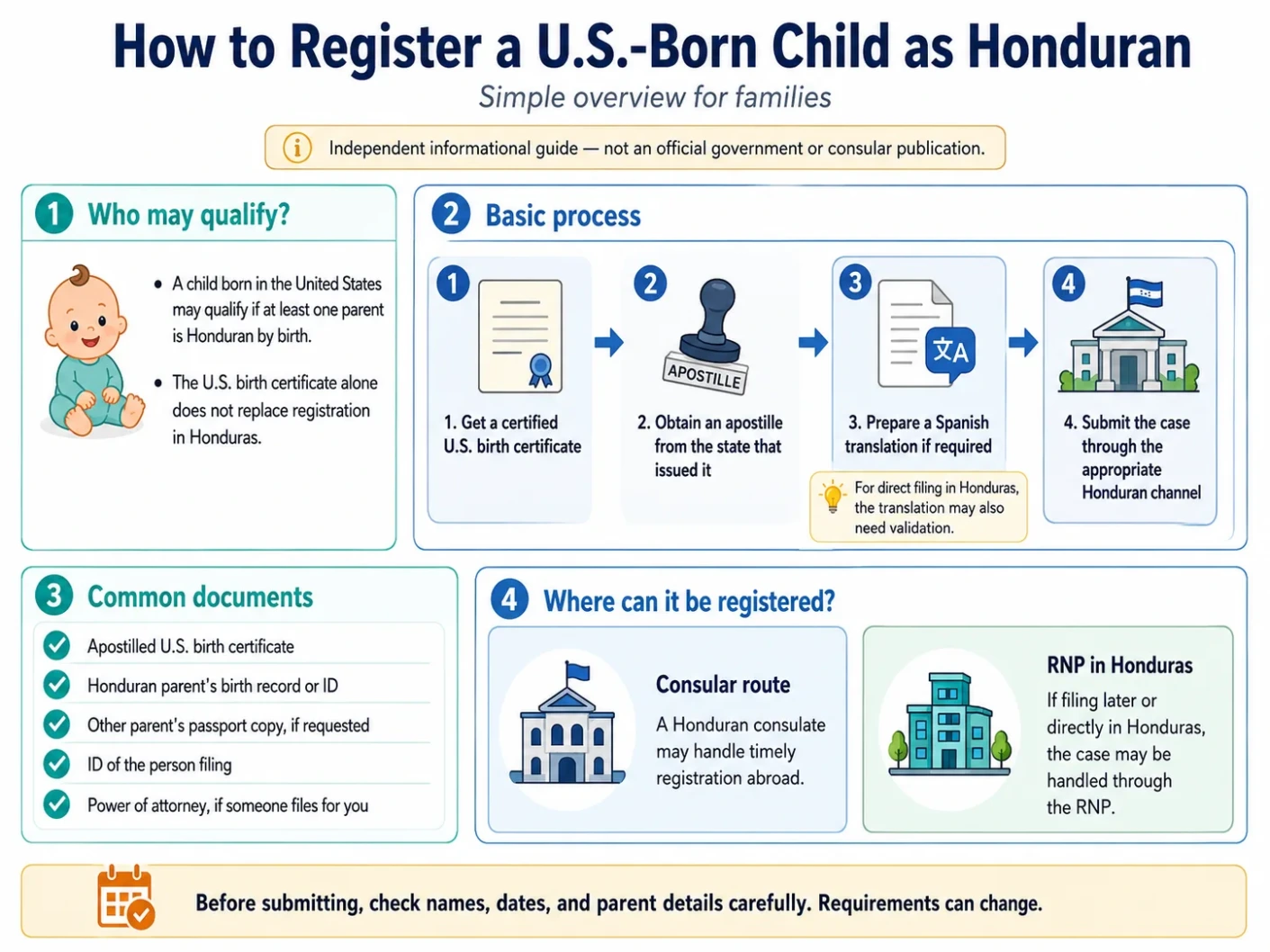
A child born in the United States may be registered in Honduras when Honduran nationality by birth applies through the child’s father or mother. A U.S. birth certificate proves that the birth occurred in the United States, but it does not replace registration of the birth with Honduras’s Registro Nacional de las Personas (RNP). For a case filed directly in Honduras, the RNP lists the apostilled foreign birth certificate as the core document and requires additional records concerning the parents, a Spanish translation when applicable, and identification for the person filing the request.[1]
For a birth registration filed directly with the RNP in Honduras: the U.S. birth certificate must be apostilled. If the certificate is in English, the RNP’s official requirements call for a Spanish translation and validation through the Honduran Ministry of Foreign Affairs. Documents establishing the parents’ identities and the identity of the person filing the case are also required.
Important: This is an independent informational page, not a Honduran government or consular website. Requirements can change, so confirm time-sensitive details with the office or official agency handling your service.
Who can be registered as Honduran by birth
Article 23 of the Constitution of Honduras includes among Hondurans by birth those born abroad to a father or mother who is Honduran by birth. The official constitutional text also notes that this provision was interpreted through Decree No. 13-2001. That interpretation addresses situations in which the Honduran parent was also born abroad and must establish his or her Honduran nationality by blood.[2]
This makes it important to distinguish between having a parent who is Honduran by birth and other ways of acquiring Honduran nationality. Article 23.2 specifically addresses the first situation. If the child’s only connection is through a parent who became Honduran by naturalization, the same birth-registration rules should not automatically be assumed to apply.
Consulate or RNP: the two registration routes
The RNP distinguishes between a birth registered on time through a Honduran diplomatic or consular officer and a registration later requested directly through the RNP. Under the consular route, the diplomatic or consular officer sends the registration certification for incorporation into Honduras’s civil registry. If the birth was not registered through that route within the applicable period, the RNP states that the interested party may request registration directly with the institution.[3]
| Situation | Published route | Main point |
|---|---|---|
| Registration within the applicable period | Honduran diplomatic or consular officer | The consular registration is forwarded for incorporation into the Honduran civil registry. |
| Birth not registered on time | Registro Nacional de las Personas | The interested party may request registration through the RNP. |
| Case filed directly in Honduras | RNP Secretaría General | The process uses the apostilled foreign birth certificate and the other documents published for this route. |
Documents required when filing directly in Honduras
The RNP Secretaría General requirements for registering Hondurans born abroad list the following documents and conditions.[4]
| Document or requirement | When it applies |
|---|---|
| Apostilled foreign birth certificate | For the person born in the United States who will be registered. |
| Spanish translation | When the certificate is in a foreign language. The RNP also requires validation through the Honduran Ministry of Foreign Affairs. |
| Birth-record certification for the Honduran parent or parents | To establish the identity and Honduran record of the parent or parents. |
| Copy of the foreign parent’s passport | When one parent is not Honduran; the RNP states that it is used to verify the name against the birth certificate. |
| Identification of the person filing the case | To identify the person appearing before the RNP. |
| Power of attorney | When a representative or legal agent files the case. |
| Request addressed to the RNP commissioners | Completed as part of the Secretaría General procedure. |
| Originals and copies | The official RNP requirements request both. |
The same RNP document expressly states that the Secretaría General request does not require payment of a TGR-RNP fee. This refers to the RNP registration procedure itself. It does not include amounts that may be charged in the United States for obtaining a certified birth certificate, securing an apostille, or arranging a translation.
How to prepare the U.S. birth certificate
Obtain a certified copy of the birth certificate
For a person born in the United States, the birth certificate should come from the official vital-records system for the state or territory where the birth occurred. USA.gov directs applicants to request certified copies from the vital records office in the state or territory of birth.[5]
A document issued by the hospital should not be confused with the certified civil birth record. For Honduran registration purposes, the relevant document is the official certificate issued by the government authority that maintains the birth record.
There is no single national office that issues all U.S. birth certificates. The procedure for ordering a certified copy, the fee, and the available certificate formats depend on the state or territory where the child was born.
The apostille comes from the state that issued the certificate
Birth certificates are state-level documents. USA.gov explains that vital records issued by a U.S. state need an apostille from the appropriate authority in that state when they will be used in a country participating in the Hague Apostille Convention. For state-issued documents, it identifies the appropriate state authority, commonly the Secretary of State, as the office responsible for apostilles.[6]
Document sequence: certified U.S. birth certificate → apostille from the state that issued the document → Spanish translation and validation required by the RNP for a case filed directly in Honduras.
Do not automatically send a state birth certificate to the U.S. Department of State in Washington, D.C. as though it were a federal document. The apostille authority for a state vital record is determined by the state that issued it.
Check names and birth details before requesting the apostille
Before obtaining the apostille, review the child’s full name, date and place of birth, and the names of both parents. This check matters because the RNP’s own requirements call for the foreign parent’s passport to be compared with the name shown on the foreign birth certificate.
If the U.S. birth certificate contains an actual error, the correction should begin with the vital records authority responsible for that birth record. Each state sets its own correction rules. Apostilling a certificate that later has to be replaced can mean obtaining a new apostille for the corrected document as well.
Spanish translation and validation for an RNP filing
The Secretaría General requirements state that a certificate issued in a foreign language must be translated into Spanish and validated through the Honduran Ministry of Foreign Affairs. A U.S. birth certificate issued in English falls within that requirement.
The apostille and the translation serve different purposes. The apostille authenticates a public document for international use, while the translation provides the Spanish-language version required for an English-language record. An apostille does not by itself remove the translation requirement published by the RNP for cases filed through Secretaría General.
Where the case is filed in Honduras
The RNP Secretaría General requirements state that documents for this procedure are presented at service windows in the Edificio Villatoro, bulevar Morazán, Tegucigalpa. That location appears specifically in the requirements document for this registration process.
The RNP’s general public page separately lists its institutional address as Edif. Torre Futura, Col. Palmira, frente a Distrito Hotelero Plaza San Martín, Tegucigalpa, together with the telephone number 2247-9898 and email address centrodecontacto@rnp.hn. Because a filing window listed for a particular procedure and the institution’s general address are not necessarily the same location, verify the current Secretaría General filing location before traveling.
The RNP’s published registration deadline is not consistent across its documents
Two official sources hosted by the RNP currently present different periods. The RNP’s “Nacimiento” page states a six-month period for timely birth registration and applies that framework to children born outside Honduras.
The text of the Ley del Registro Nacional de las Personas available through the RNP, however, states in Article 53 that births should be registered within one year. Article 54 says children of Hondurans born abroad may be registered before Honduran diplomatic or consular officers “within the same period.” The law also provides that when the birth was not registered on time through those officials, registration may be requested by the interested party through the RNP.[7]
If the timely-registration period has already passed: do not interpret the end of that period as a permanent bar to registering the birth. Both the RNP’s public page and the registration law provide a route through the RNP when the birth was not registered on time. Because the official sources differ between six months and one year, confirm the applicable period when dealing with a recent birth.
What changes when the person is 21 or older
The Secretaría General requirements are not limited to young children. When identifying who may appear in the case, the document states that parents or relatives may act when the registration concerns a minor and adds that an interested person who is of legal age, expressly using the reference of 21 years, may represent himself or herself.
Reaching age 21 therefore does not appear in this RNP document as an automatic loss of the ability to seek registration. Instead, the age reference is used to determine who may appear personally in the procedure. For applicants who are 18, 19, or 20, the general requirements do not separately explain a different representation rule, so that gap should not be filled with an assumption.
Foreign parent, name differences, and representation
When one parent is not Honduran
The RNP does not require both parents to be Honduran for the foreign parent’s identity to be documented. Its requirements call for a copy of the foreign parent’s passport when one parent is not Honduran and explain that the document is used to verify the name appearing on the birth certificate.
For the child’s Honduran-by-birth claim, the relevant constitutional question is whether the required connection exists through a father or mother who is Honduran by birth. The other parent’s U.S. citizenship or another nationality does not by itself remove that Honduran parent-child connection.
When names do not match between U.S. and Honduran records
A missing middle name, a different surname, or another discrepancy between a passport and the birth certificate should be reviewed before the case is filed. The RNP expressly uses the foreign parent’s passport to verify the name against the birth certificate, so a discrepancy should not be hidden or manually altered on document copies.
If the difference comes from an error in the U.S. birth certificate, the correction begins with the vital records office that maintains the record. If it results from another circumstance, such as a legal name change, the RNP’s general requirements do not publish one universal list of additional supporting documents for every possible case. Secretaría General must determine what documentation is required for that specific discrepancy.
When someone else files the documents
The RNP permits representation. Its requirements call for identification from the person filing the case and a power of attorney when a representative or legal agent acts on the applicant’s behalf. This authorization serves a different purpose from the records proving the birth and the Honduran parent’s status, so it does not replace those documents.
What should be recorded after the procedure
The purpose of the filing is to have the birth that occurred in the United States incorporated into Honduras’s civil registry. The RNP law provides that civil-status events produce their registration effects after the corresponding entry has been made.
Submitting the documents and already having a completed Honduran birth registration are not the same stage. Once the procedure has been completed, the point to verify is that the birth appears in the RNP and that the corresponding Honduran birth certification can be issued. The original U.S. records should still be retained because they document the birth that occurred in the United States.
The official sources used for this procedure do not publish one general processing time that can be applied to every registration of a person born in the United States. A specific number of days or months should therefore not be treated as a guaranteed processing period.
Official sources
- [1] RNP — Requirements for registration of Hondurans born abroad through Secretaría General — Lists the apostilled certificate, translation, parent documentation, representation requirements, originals and copies, and the statement that the request does not require a TGR-RNP payment.
- [2] Judiciary of Honduras — Constitution of the Republic of Honduras — Article 23 addresses Honduran nationality by birth for children born abroad and includes the reference to the interpretation established through Decree No. 13-2001.
- [3] Registro Nacional de las Personas — Birth Registration — Explains registration of births occurring abroad, the consular route, the option to request registration through the RNP when it was not completed on time, and the RNP’s general contact information.
- [4] RNP — Secretaría General requirements for Hondurans born abroad — Details the documents required for a case filed directly through the RNP.
- [5] USA.gov — How to get a certified copy of a U.S. birth certificate — Directs applicants to the vital records office in the state or territory where the birth occurred.
- [6] USA.gov — Authenticate an official document for use outside the U.S. — Explains apostilles for state-issued vital records and distinguishes state documents from federal documents.
- [7] RNP — Law of the Registro Nacional de las Personas — Articles 53 and 54 contain the registration period stated in the law and address children of Hondurans born abroad whose births were not registered on time through diplomatic or consular officers.