
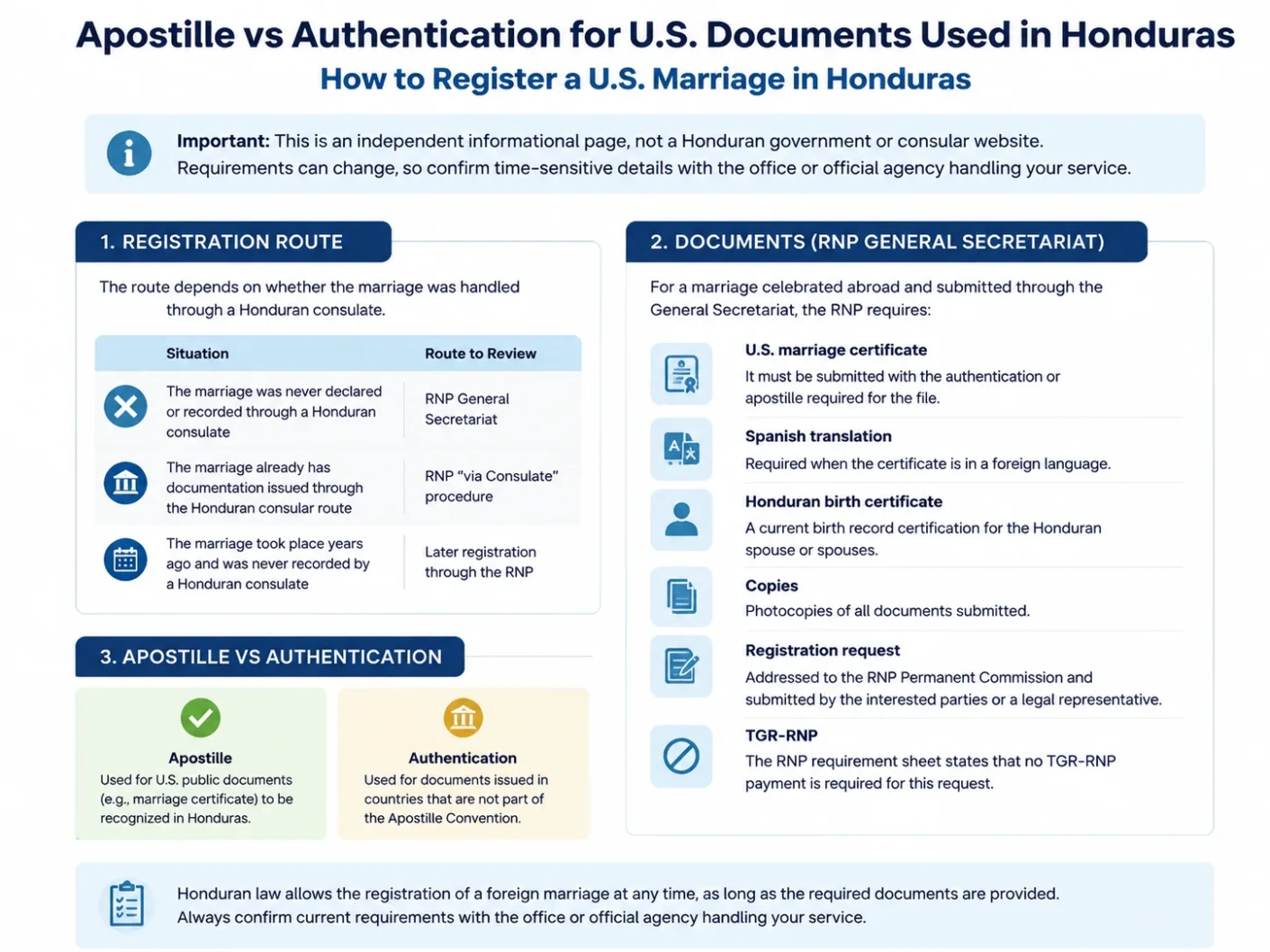
A marriage legally celebrated in the United States is not automatically added to Honduras’s Registro Nacional de las Personas (RNP). For the marriage to appear in the Honduran civil registry, it must be registered through the applicable procedure. When the marriage was not previously recorded before a Honduran diplomatic or consular official, the RNP regulations allow the Honduran spouse or spouses — and, in certain cases, qualifying relatives — to request registration later, including “at any time.”[1]
Important: This is an independent informational page, not a Honduran government or consular website. Requirements can change, so confirm time-sensitive details with the office or official agency handling your service.
The registration route depends on whether the marriage went through a Honduran consulate
The RNP publishes different requirements for marriages celebrated abroad depending on how the marriage documentation reaches the Honduran registry. Identifying the correct route before paying for an apostille, translation, or document shipment can prevent unnecessary steps.
| Situation | Route to review | What changes |
|---|---|---|
| The marriage was never declared or recorded through a Honduran consulate | RNP General Secretariat | The foreign marriage certificate is submitted with the required validation, Honduran records, and registration request. |
| The marriage already has documentation issued through the Honduran consular route | RNP “via Consulate” procedure | The RNP publishes a separate document list for this type of file. |
| The marriage took place years ago and was never recorded by a Honduran consulate | Later registration through the RNP | The regulations allow the registration to be requested at any time, subject to the required documentation. |
Honduran RNP law and regulations also provide for Honduran citizens who marry abroad to declare the event before Honduran diplomatic or consular officials. This does not mean every case started from the United States is completed entirely at the consulate. The RNP maintains procedures for incorporating the foreign marriage into the Honduran civil registry.
Documents for registration through the RNP General Secretariat
For a marriage celebrated abroad and submitted through the General Secretariat, the RNP requirement sheet lists an authenticated or apostilled marriage certificate, a translation when the document is in another language, current Honduran birth certificates for the Honduran spouse or spouses, photocopies, and a request addressed to the RNP Permanent Commission. The same RNP document states that no TGR-RNP payment is required for this request.[2]
| Document | Published requirement |
|---|---|
| U.S. marriage certificate | It must be submitted with the authentication or apostille required for the file. |
| Spanish translation | Required when the certificate is in a foreign language; the RNP requirement sheet also refers to processing the translation through Foreign Affairs. |
| Honduran birth certificate | A current birth record certification for the Honduran spouse or spouses. |
| Copies | Photocopies of all documents submitted. |
| Registration request | Addressed to the RNP Permanent Commission and submitted by the interested parties or a legal representative. |
| TGR-RNP | The RNP requirement sheet states that no TGR-RNP payment is required for this request. |
About costs: No TGR-RNP payment does not mean every part of the process is free. Obtaining a certified U.S. marriage record, an apostille, or a translation involves separate services whose fees depend on the issuing authority or service provider.
Which marriage document to obtain in the United States
The document relevant to the RNP is the official marriage certification or certified marriage record. The exact name varies by state and by the authority maintaining the record. It may be called a marriage certificate, certified copy of marriage record, or another equivalent term.
Do not confuse the marriage license with the final marriage record
Do not request an apostille for a basic marriage license without first confirming that the document shows the marriage was actually completed and recorded. The RNP asks for a marriage certification, so the document obtained from the appropriate U.S. authority should be a certified record establishing the completed marriage.
U.S. document: Do not send an ordinary photocopy for an apostille. First obtain an acceptable original or certified copy issued by the authority responsible for the marriage record.
Check names and surnames before requesting the apostille
Compare the U.S. marriage record with the Honduran birth certificate, DNI, or passport used for identification. Check full names, first and second surnames, the date and place of marriage, and any other identifying information appearing on both records.
This matters because Article 144 of the RNP regulations states that the marriage registration is completed using the information appearing in the document that records the marriage. A genuine discrepancy in the U.S. record should not be “fixed” by changing a name in the Spanish translation. If the U.S. record contains an actual error, the correction belongs with the authority that issued or maintains that record.
Where to apostille a U.S. marriage certificate for use in Honduras
The United States and Honduras are parties to the Hague Apostille Convention. For Honduras, the Convention entered into force on September 30, 2004.[3] For a U.S. marriage record, the authority that handles the apostille is determined by the jurisdiction that issued the document, not by the state where the couple currently lives.
The U.S. Department of State distinguishes federal documents from state-issued documents. For a state public document intended for use in a Hague Convention country, it directs applicants to the appropriate authority in the state that issued the document. The federal authentication process of the U.S. Department of State applies to federal documents and other documents under its jurisdiction.[4]
| Document | Authority to review |
|---|---|
| Marriage record issued by a state, county, or local authority | The competent authority in the state where the document was issued. Some states require additional certification steps before the apostille. |
| Document issued by a U.S. federal agency | The U.S. Department of State federal authentication procedure, when applicable. |
For example, if the marriage record was issued in Texas but the couple now lives in Florida, moving to Florida does not turn the certificate into a Florida record. The apostille must follow the rules applicable to the Texas-issued document.
The RNP wording on apostille and legalization should be checked carefully
The RNP General Secretariat requirement sheet uses wording that refers to a document being “authenticated or apostilled by the Embassy of Honduras in the place where the marriage took place and by Foreign Affairs.” At the same time, the current Hague Apostille Convention system designates competent authorities for apostilling U.S. public documents. Because these descriptions do not use the same procedural terminology, applicants should not automatically add a consular legalization chain after obtaining a valid apostille without confirming how the RNP General Secretariat currently applies its published requirement to that specific document.
The apostille is also not necessarily issued by the same office that provides the certified marriage copy. Some states require intermediate certification steps before the document reaches the state authority authorized to issue an apostille. Follow the instructions published by the state that issued the marriage record.
When the U.S. marriage certificate must be translated into Spanish
A marriage certificate written in English falls within the RNP requirement for a document issued in a foreign language. For the General Secretariat route, the published requirement calls for a translation and also refers to processing the translated document through Foreign Affairs.
The translation should preserve the identifying information shown on the original document. Names and surnames should not be translated, rearranged, or modified simply to make them match a Honduran record. A translation communicates the content of the certificate; it does not replace an official correction of the U.S. record.
Practical order of the process from the United States to Honduras
- Obtain the official marriage certification. Request the certified record establishing the registered marriage from the appropriate U.S. authority.
- Compare the personal information. Check names, surnames, and other identifying details against the Honduran records before starting the apostille process.
- Identify the jurisdiction that issued the record. The issuing state determines the U.S. authority that handles the applicable apostille or certification.
- Complete the required apostille or validation. Follow the rules of the issuing state and keep the marriage record and its apostille together as one document package.
- Prepare the Spanish translation when required. Also account for the RNP’s published requirement concerning Foreign Affairs.
- Obtain a current Honduran birth certificate. The RNP requests a current birth record certification for the Honduran spouse or spouses.
- Prepare photocopies and the written request. The General Secretariat requires copies of the documents and the corresponding registration request.
- Submit the file to the RNP General Secretariat. The RNP requirement sheet states that this department reviews the documents and issues an official communication.
- Take the communication and supporting documents to the appropriate Municipal Civil Registry. This is the stage at which the marriage is entered into the Honduran civil registry.
Which municipality in Honduras registers the marriage
For a marriage celebrated abroad that was not recorded before a Honduran diplomatic or consular official, Article 143 of the RNP regulations states that registration is made in the municipality where the Honduran spouse’s birth is registered. The General Secretariat requirement sheet also states that, after reviewing the file, the RNP issues a communication that must be submitted with the documents to the Municipal Civil Registry where the marriage will be registered.
If both spouses are Honduran but their births are registered in different municipalities, the published requirement sheet does not explain how the RNP selects between those municipalities. In that situation, the appropriate Municipal Civil Registry should be identified through the communication issued by the General Secretariat rather than assumed in advance.
Who can handle the registration if the spouses remain in the United States
Not being able to travel immediately to Honduras does not mean the marriage must remain unregistered. When there was no consular registration, Article 143 allows the Honduran spouse or spouses to request registration and also allows relatives within the fourth degree of consanguinity to do so when the family relationship is properly documented.
The General Secretariat requirement sheet also allows the request to be submitted by the interested parties or by a legal representative. These are different categories. A relative acting under the family relationship recognized in the regulations should not automatically be treated as the same thing as an attorney-in-fact or legal representative.
If the marriage file comes through the Honduran consular route
The RNP publishes a separate requirement sheet for the “registration of marriages of Hondurans celebrated abroad via Consulate.” It requests the marriage certificate corresponding to that route, recent Honduran birth certificates for the Honduran spouses, identification for the person submitting the documents, and a power of attorney when a representative or legal agent acts on behalf of the interested party. It also requires originals and copies and states that no TGR-RNP payment is required.[5]
Two different files: Do not automatically combine the General Secretariat requirements for a foreign marriage certificate with the RNP requirements for a file coming through the consular route. First determine what document you have and how the marriage was previously recorded.
A marriage from years ago can still be submitted for registration
The RNP regulations contain a specific rule for marriages celebrated outside Honduras that were never recorded before a Honduran diplomatic or consular official. The Honduran spouse or spouses, or authorized qualifying relatives, may request registration at any time. The number of years that have passed since the wedding does not by itself eliminate this registration route.
Registration period: Do not automatically apply deadlines governing marriages celebrated or registered inside Honduras to a marriage celebrated in the United States. The RNP regulations contain a separate rule for a foreign marriage that was not previously recorded through a Honduran consulate.
If one spouse is American and the other is Honduran
The registration procedure is not limited to couples in which both spouses are Honduran. The RNP regulations refer to the “Honduran spouse or spouses,” and the General Secretariat requirement sheet asks for current birth certifications for the Honduran spouses.
An American spouse therefore should not be assigned a requirement that cannot apply, such as presenting a Honduran birth certificate. The published General Secretariat list does not impose that document on a person who is not Honduran. If the RNP requires additional identification or documentation from the foreign spouse in a particular file, the requirement applicable to that case should be followed.
Situations that should be resolved before the marriage file is submitted
The Honduran spouse’s name does not match across the records
A difference between the U.S. marriage record and the Honduran civil record should be reviewed before paying for an apostille and translation. The issue might involve a missing middle name, a different surname order, a spelling error, or a genuine legal name change. Because the RNP uses the information shown in the marriage document to make the registration, a material discrepancy can require determining which underlying record needs correction first.
The U.S. marriage record was corrected after it was issued
If the U.S. authority later issued a corrected or amended marriage record, continuing to use an older version only because it already has an apostille can create mismatched documentation. An apostille relates to the specific document presented for certification. The records submitted in Honduras should correspond to one another.
A previous marriage or foreign divorce is not yet reflected in Honduras
When the marital status recorded in Honduras does not match the status underlying the new U.S. marriage, the case is no longer limited to registering a single foreign marriage record. Registering the new marriage should not be assumed to automatically correct a divorce, annulment, or other prior civil-status event that has not yet been entered in the RNP. Those events have separate registration procedures.
Marriages whose recognition is restricted under the Honduran Constitution
A marriage being valid under the law of the U.S. state where it was celebrated does not by itself establish that it can be registered in Honduras. The text of Article 112 of the Honduran Constitution published by the Honduran Judiciary states that same-sex marriages or de facto unions celebrated or recognized under the laws of other countries do not have validity in Honduras.[6] A case falling under this provision should not be treated as an ordinary foreign-marriage registration file and requires verification of the applicable legal framework with the competent authority.
What happens after the documents reach the RNP General Secretariat
The RNP requirement sheet describes two stages. First, the documents are submitted to the General Secretariat so that it can issue an official communication. The documents and that communication are then presented to the Municipal Civil Registry where the marriage will be entered.
Submitting the file to the General Secretariat is therefore not the same as having the marriage fully registered. The relevant result is that the marriage has actually been incorporated into the appropriate Honduran civil registry and can be documented through the corresponding RNP marriage certification.
The RNP requirement sheets used for this procedure do not publish a general processing time. A specific number of days or months should therefore not be presented as the official processing period based on old forms or non-government websites.
Final verification: Keep the communication issued by the General Secretariat and any receipt or proof issued by the Municipal Civil Registry. The purpose of the procedure is for the marriage to be entered into the Honduran registry, not simply for the documents to be received.
Official Sources
- [1] RNP — Regulations of the Law of the National Registry of Persons — Articles 143 and 144 address marriages of Honduran citizens celebrated abroad, later registration when there was no consular record, qualifying relatives who may request it, the municipality of registration, and the information used to create the marriage entry.
- [2] RNP — Requirements for Registration of a Marriage Celebrated Abroad Through the General Secretariat — Lists the marriage certification, translation, Honduran birth records, copies, request, TGR-RNP rule, and the subsequent step at the Municipal Civil Registry.
- [3] HCCH — Status Table for the Apostille Convention — The official status table identifies Honduras and the United States as parties to the Convention and provides the applicable entry-into-force information.
- [4] U.S. Department of State — Prepare a Document for an Apostille Certificate — Distinguishes federal documents from state documents and directs state-issued records to the appropriate authority in the issuing state.
- [5] RNP — Requirements for Registration of a Marriage Celebrated Abroad Through a Consulate — Lists the documentation, identification, representation, originals, copies, and other requirements published by the RNP for files coming through the consular route.
- [6] Honduran Judiciary — Constitution of the Republic, Article 112 — Contains the constitutional provision concerning recognition in Honduras of certain marriages and de facto unions celebrated or recognized in other countries.